Aesthetics
AI Cinema
AI cinema is the craft of directing AI video with real cinematic grammar — aesthetics, camera, light, and color — not a single filter look.
Preview coming soon.
Visual signatures
- clear aesthetic intent before generation
- camera and light language in every prompt
- negative lists to block style drift
- links into named aesthetics and technique categories
Camera & light
- Palette
- Depends on the chosen aesthetic — pick one primary grade direction per shot
- Camera grammar
- Name a real move (dolly, handheld, tracking) instead of vague cinematic
Bridge page: send readers to named aesthetics and technique categories; keep prompts tool-agnostic.
Prompt
Copy-ready prompts in three tiers. Tool-agnostic — use with any video model.
Short
16:9 AI cinema look, clear film-style intent, named camera move, motivated lighting, coherent color grade, original scene
Standard
16:9 AI cinema workflow: choose one aesthetic (e.g. cyberpunk or Wes Anderson film style), add camera grammar and lighting, then a short negative list. Original characters only.
Full
16:9 cinematic AI cinema directing template: a method, not a single filter look. Decide one aesthetic before generating, name a real camera move, write the light, pick one primary grade direction, and close with a negative list that blocks style drift. Never write only the word cinematic without camera grammar, never mix conflicting aesthetics in one shot, and keep tool brand names out; any video model works. Borrow each slot's wording from the named aesthetic pages and technique categories. Template, fill every slot: 16:9 cinematic [AESTHETIC: one named style] aesthetic, not [NEIGHBOR STYLE to exclude]. Scene: [ORIGINAL SUBJECT, wardrobe] in [SETTING, time of day]. Start: [shot size, angle, subject position]. Motion: [ONE real move: dolly, handheld, tracking, crane or locked hold] over [DURATION, about 8 seconds] while [one subject action]. End: [final frame]. Camera: [focal length], [aperture and depth of field], [height]. Light: [practical sources], [key direction and hardness], [white balance in kelvin]. Color: [ONE primary grade direction], [three palette hues], [grain or medium]. Avoid: [three to five drift blockers], celebrity likeness, logos. Filled example: 16:9 cinematic cyberpunk aesthetic, not tech-noir or rainy-neon-night. Scene: an original courier with a cybernetic forearm, in a yellow rain shell, repairing a delivery drone under a market awning in a crowded megacity alley at night. Start: low-angle wide shot, courier centered among steaming stalls. Motion: slow dolly-in over eight seconds while solder sparks fall and holographic billboards flicker overhead. End: medium close-up as the metal hand snaps the drone hatch shut. Camera: 32 mm, f/2.8, moderate depth of field, knee height. Light: neon signage and hologram glow as the only key, magenta from the left, cyan rim, steam for volume, 4000 K white balance. Color: teal-green shadows with magenta highlights, yellow accent, fine digital grain. Avoid: empty clean streets, sunny daylight, pastel symmetry, readable brand signs, celebrity likeness, logos.
Negative prompt
vague cinematic only with no camera grammar
mixed conflicting aesthetics in one shot
celebrity likeness
logos
Related styles
- Cyberpunk Aesthetic
Cyberpunk aesthetic is a high-tech, low-life film style: rain-soaked megacities, neon signage, steam, crowded streets, and cybernetic detail under mixed practical light.
- Wes Anderson Film Style
Wes Anderson film style is a dollhouse of centered symmetry, pastel candy color, planimetric staging, lateral tracks and whip pans — whimsical melancholy without actor likeness.
- Wong Kar-wai Film Style
Wong Kar-wai film style is neon-and-tungsten urban loneliness — step-printed smear, handheld intimacy, foreground obstruction, and missed connections — without requesting actor likeness.
Related techniques
- Dolly Translation
Translate the camera through the declared path at fixed focal length. Let foreground/background perspective change; focus may track distance, and only explicitly declared aiming compensation is allowed.
- Motivated and Naturalistic Reinforcement
Match any added source to an established direction, spectrum and falloff. In the naturalistic variant keep enhancement unobtrusive and preserve ordinary room shadows; do not add an unexplained beauty rim.
- Color Grading and Natural Correction
Work from a correctly color-managed plate and maintain stable material relationships over time. Choose the declared stylized or natural target without geometry changes, automatic hue cycling or channel clipping.
FAQ
- What is AI cinema on GrokCine?
- A bridge: use named film styles and technique grammar so AI video reads as directed cinema, not random pretty frames.
- Do I need a specific video model?
- No. Prompts here are craft-first and work with any video model; we do not optimize titles for tool brands.
Shot cards
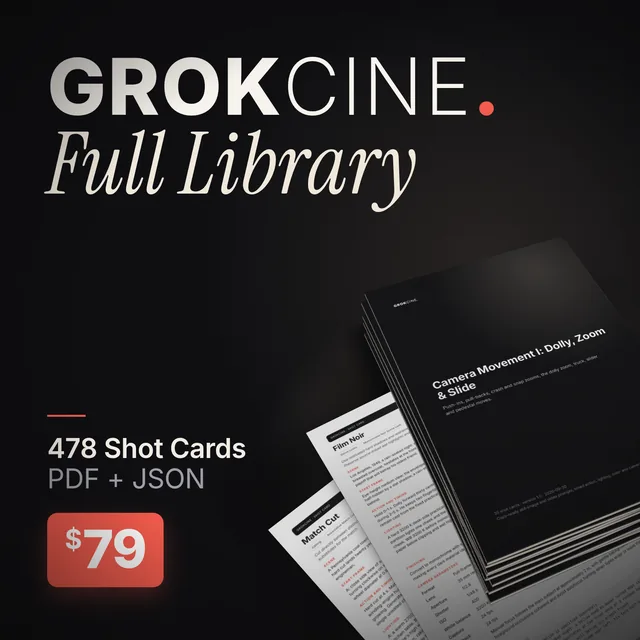
The full recipe for AI Cinema is a shot card
The full recipe for AI Cinema is a shot card. The start and end frames, timed action, lighting and color specs, a camera parameter table, copy-ready still-image and video prompts and negatives are in The Full Library. (478)